
Where words fail, numbers prevail
The Hidden Danger of Ambiguous Legal Language
Imagine this scenario: In preparing for mediation, plaintiff’s counsel tells their client, “I think we have a good case.” The lawyer believes they’re communicating a 60% probability of success. The client, however, interprets this as an 80% chance of winning.
When discussing potential damage awards, counsel states that the “most likely” award is $450,000, with $325,000 being “less likely” and $675,000 “least likely.” Once again, lawyer and client attach vastly different probabilities to these qualitative terms.
This isn’t mere miscommunication—it’s a fundamental barrier to effective settlement decisions. As a mediator, I’ve witnessed this scenario in Ontario cases, where mismatched risk assessments and expectations can doom settlement discussions before they even begin.
Quantifying the Interpretation Gap: Evidence from Ontario Lawyers
At a recent Advocates’ Society conference on “Mediation Strategies,” I conducted a revealing poll among experienced litigation lawyers. I asked them to translate common phrases used at mediation into specific probabilities of success. The results were startling:
| Common Phrase | Interpretation Range | Gap |
| “I think we have a good case” | 40% to 80% | 40% |
| “We know this case is an uphill battle” | 10% to 45% | 35% |
| “I think we have a decent chance at winning” | 35% to 75% | 40% |
| “I like our chances” | 50% to 80% | 30% |
| “We have a very good case on breach. Our biggest challenge is causation” | 10% to 70% | 60% |
The results show no consensus about what these commonly used phrases actually mean, even among experienced litigators. The narrowest interpretation gap was 30%, while the widest reached 60%. Let that sink in.
When Different Expectations Lead to Missed Settlement Opportunities
In Ontario’s loser-pays jurisdiction, the stakes of this misalignment are particularly high. When parties reject reasonable settlement offers based on inflated expectations, they face:
- Losing their case entirely
- Incurring substantial future legal fees
- Paying a portion of the opposing party’s costs
Case Study: The Cost of Miscommunication
Consider our earlier example:
Lawyer’s Interpretation:
- “Good case ” = 60% probability of success on liability
- “Most likely” damage award ($450,000) = 60% probability
- “Less likely” damage award ($325,000) = 30% probability
- “Least likely” damage award ($675,000) = 10% probability
Client’s Interpretation:
- “Good case” = 80% probability of success
- “Most likely” damage award ($450,000) = 80% probability
These dramatically different perspectives yield vastly different settlement values. When the defendant offers $260,000 at mediation, the client rejects it as inadequate based on their overly optimistic assessment and holds out for $360,000.
In my experience as a mediator, this expectation gap is one of the primary reasons cases fail to settle. Clients arrive with unrealistic expectations based on their misunderstanding of success probabilities and risk exposure, creating an unbridgeable gap between offers and expectations.
Decision Tree Analysis: Bridging the Language Gap
Decision tree analysis transforms settlement discussions by providing:
1. Visual Clarity
Clear diagrams showing each court decision point for liability and damages
2. Explicit Probabilities
Specific percentages that eliminate interpretation errors
3. Risk Adjusted Value
Mathematical foundation for settlement decisions based on the risk adjusted value of the case
4. Cost Consequences
Integration of Ontario’s loser-pays rules
5. Net Outcome Analysis
All possible trial outcomes, including damages, interest, and costs, adjusted for future legal expenses
This transparency builds trust between lawyer and client while supporting informed decision-making.
Real-World Example: Decision Tree Analysis in Action
Let’s apply decision tree analysis to our relatively simple case. In addition to liability and damages, we will include prejudgment interest and legal costs so that the plaintiff has a complete picture of each possible outcome at trial and the probability of it occurring, based on their lawyer’s assessments. Assume that the successful party at trial will be awarded costs on a partial indemnity basis equivalent to 66% of the legal fees they incurred.
Additional Facts
- Plaintiff’s incurred costs: $25,000
- Plaintiff’s estimated additional costs through trial: $55,000
- Defendant’s estimated incurred costs: $30,000
- Defendant’s estimated additional costs: $65,000
- Prejudgment interest: 4.8% from July 8, 2024
- Estimated trial decision: May 4, 2027
Decision Tree Visualization
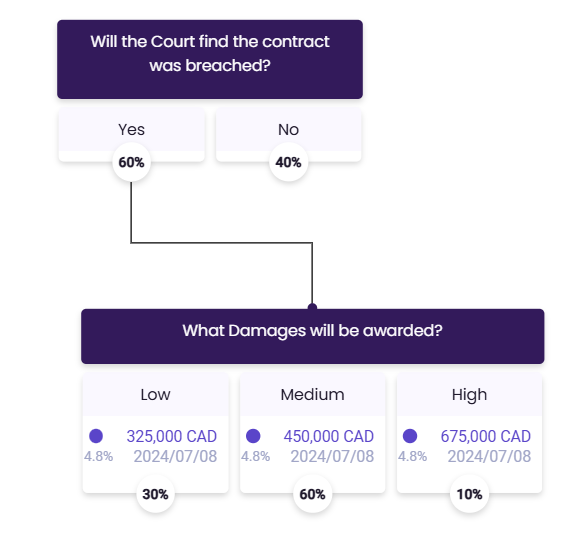
Comprehensive Outcome Analysis:
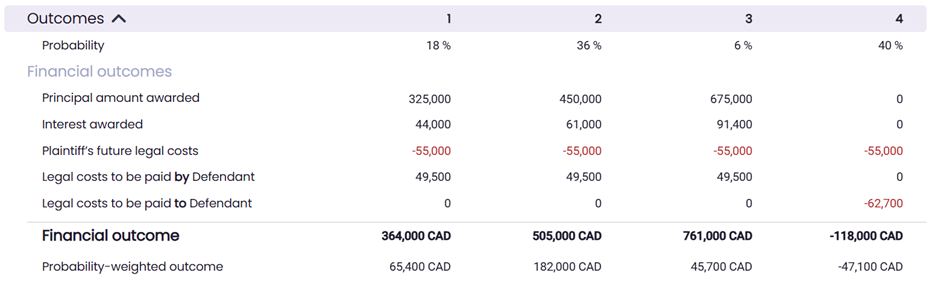
Here are the four possible outcomes at trial and the Financial Outcome of each. Financial Outcome is the amount the plaintiff will be financially ahead or behind where they are at the mediation if that is the outcome at trial.
The first three numbered columns show the damage award, prejudgment interest on that award, the future legal costs the plaintiff will have to incur through trial, and the partial indemnity cost award the plaintiff is expected to receive if they are successful. The probability of each outcome is also indicated. It is based on multiplying the probability of the plaintiff’s success on liability by the probability of each damage award. For example, the probability of the court awarding $325,000 in damages is 18% (60% x 30%). The fourth numbered column shows the financial outcome if the plaintiff loses at trial.
Risk Adjusted Value
Based on these probabilities, the risk adjusted value of this case from the plaintiff’s perspective is $246,000. This figure is the sum of every Probability-weighted outcome (the last line in the chart above). Put another way, this risk adjusted value recognizes that the plaintiff has a 6% chance of “knocking it out of the park” with a Financial Outcome of $761,000, a 36% chance of $505,000, an 18% chance of $364,000, as well as the 40% chance that the plaintiff will lose the case and be out of pocket an additional $118,000 given the future legal costs they will incur for the trial and the partial indemnity costs they will have to pay to the defendant.
Key Insight
If the plaintiff can settle for $246,000 or more, that constitutes a rational settlement amount given their counsel’s risk assessment. The defendant’s $260,000 offer at mediation actually exceeds this threshold, making it a favorable settlement opportunity. However, if we were consulted on this case, our litigation decision analysis would reveal additional value by identifying the complete Zone of Possible Agreement—the monetary range where both parties achieve a win-win settlement outcome.
Our comprehensive risk assessment analyzes the case from both perspectives, enabling the plaintiff to make a strategic counter-offer above $260,000 that remains more favorable to the defendant than its own risk-adjusted case valuation, even if the defendant has a more pessimistic view of the plaintiff’s chance of finding it liable.
Want to know how much higher that counter-offer could realistically be while still creating a win-win outcome? Contact us to see how strategic litigation risk assessment can maximize your settlement outcomes.
Implementing Decision Tree Analysis in Your Practice
At Settlement Value, we’ve built our practice around eliminating ambiguity in settlement discussions. Our litigation decision tree analysis creates a common language that lawyers and clients understand with equal clarity.
Our Services Include:
For Law Firms and Corporate Law Departments:
- Comprehensive inhouse decision tree analysis training
- Easy-to-use software implementation
- Case specific consultations
For Lawyers:
- Case-specific consultation services
Why Choose Settlement Value?
We help legal professionals:
- Communicate risk clearly and accurately
- Make data-driven settlement decisions
- Avoid costly miscommunications
- Improve client satisfaction and outcomes
Transform Your Settlement Negotiations Today
Ready to bring clarity to your settlement discussions? Contact Settlement Value to learn how decision tree analysis can improve your litigation outcomes.
Settlement Value provides decision tree analysis consulting services and training for litigators throughout Ontario and Canada. We help legal teams replace subjective language with explicit analytical frameworks that support better settlement decisions.
#LitigationAnalysis #SettlementValue #DecisionAnalysis #Mediation #OntarioLaw #LegalTech #RiskAssessment #SettlementNegotiation